We have a friend who recently traveled to a place that we’re not going to name (for reasons that will become obvious). During this trip, the friend had to pass through a security checkpoint with thousands of other people. And as you might expect, it caused the usual slowdowns.
This security checkpoint looked a lot like others this friend had been through in the past. There were uniformed security officers and a maze-like rope line. There was also a large door-like structure that looked to be a metal detector or something similar.
But the thing is, this “detector” wasn’t making the usual beeping sounds that you might have heard from similar arrangements in airports. It had some obvious lights on the frame, but they weren’t ever illuminating. And when this friend looked off to the side, they could see a cord for the “detector” wasn’t even plugged in.
Despite this obvious flaw in the system, everyone was dutifully passing through the gate.
When the friend later mentioned this to someone who lived nearby, they said, “Oh yeah, that’s just security theater. The point is just to make people feel safe.”
Forecasting theater
Hopefully, your company isn’t performing this kind of security theater. But we’re willing to bet that your sales ops group participates in another kind of “theater” that is almost as pointless.
Most sales organizations go through a regular forecasting process. Reps submit their estimates for the month or the quarter based on what they have in their pipeline.
Knowing that it’s better to under-promise and over-deliver, most of them sandbag a little bit to protect themselves.
The managers are familiar with this game, so they pad the estimates a bit to compensate. Sales leadership looks at the historical pattern and makes another adjustment. Finance tweaks the numbers again based on their skeptical appraisal.
When the final numbers hit the CEO’s desk, she barely looks at it. Based on experience, she knows it probably has very little relationship to reality.
The cost of gamesmanship
Just like the security theater scenario, everyone plays along with this forecasting theater.
But nobody actually trusts the numbers.
Instead, any insight that arises comes through hallway conversations, gut feelings and pattern recognition that exists outside the official forecast.
This might seem like a harmless ritual, but it carries some real costs:
- Resource planning is based on guesswork because nobody believes the forecast.
- Business decisions around manufacturing and inventory become more difficult.
- Leadership delays strategic decisions because they don’t have confidence in projections.
- Everyone wastes time and energy on a process that produces fiction.
Breaking away from theatrics
So how do you move away from this elaborate show?
Take human bias and gamesmanship out of the equation by relying on actual numbers. Leading sales ops teams are using data-driven approaches, statistical models, and historical patterns to create forecasts that don’t rely on individual reps’ optimism or sandbagging.
More importantly, they are creating forecasts that are a lot more reliable.
If you’d like to learn how to do this at your company, check out Developing Better Forecasts. It outlines multiple ways to develop data-driven forecasts that you can update more frequently. And it explains how to use those numbers generated by your sales people more effectively so that you aren’t just wasting time on a ridiculous exercise.
The point of security theater may be to make people feel safe, but our friend sure didn’t feel safe after experiencing it firsthand. In a similar way, forecasting theater is meant to give leadership confidence, but it leaves everyone feeling completely unconfident about what is likely to happen.
But by moving away from these pointless processes, you can actually create the conditions you were hoping to achieve in the first place.
Developing Better Forecasts
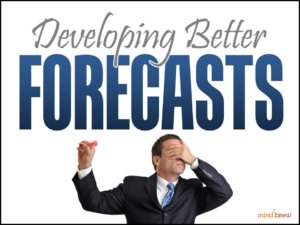
In this on-demand webinar, learn about the seven major ways in which leading teams are approaching sales forecasting very differently to boost speed, accuracy, and overall performance and results.