Our culture is fascinated by detectives. Crime and mystery novels are the best-selling books in the UK and the second best-selling type of books in the US, accounting for more than $725 million in annual sales. No matter what time of day or night you turn on the television, you’re sure to find an episode of Law & Order (or one of its many spin-offs). And they’ve remade the Sherlock Holmes stories so many different ways that it’s difficult to keep track.
One of the things that every good mystery has in common is a detective who knows which clues are important—and which are irrelevant. Everyone else on the scene may see little more than a mass of blood and gore, but somehow the lead investigator knows that the murderer is a left-handed, cat-loving welder who plays violin in his spare time.
When it comes to your sales data, you need to be a little bit like one of those star detectives. You have loads of information at your fingertips, and it’s up to you to figure out what’s important and what isn’t.
Today’s technology is amazing at finding correlations among seemingly unrelated data points. You might discover that your software sales decline when the stock market has a good week, that your five biggest customers buy your five least popular products, or that your worst salesperson is uncommonly good at selling support contracts. Do any of those things matter? Maybe. Maybe not.
You see, data is only helpful if you can do something with it. That’s why we encourage sales ops professionals to get as much training as they can in four key areas:
- How to use sales data for driving performance (and not just reports)
- Where you can point the sales team to find more opportunities for growth
- Which metrics management can affect
- How to diagnose the real root-cause of sales problems
And of course, SellingBrew has some resources to help you improve in each of these areas. For help with driving performance, check out Beyond Reporting with Sales & Pipeline Analysis. This on-demand webinar offers very specific strategies for finding the most important clues hidden in your data.
How to Use Sales Analysis to Drive More Growth takes a similar approach but focuses on the questions that will help you increase sales.
The express guide Sales Metrics Sales Leaders Should Be Managing explains which data points are most important from a management perspective.
And Diagnosing Sales Problems offers a diagnostic technique for finding the root cause of issues that might be plaguing your sales team.
In crime stories, the hero often has innate powers of observation that make him better than mere mortals at finding criminals. But in the real world, anyone can get better at solving mysteries. Getting the right training today can vastly improve your ability to sort out the important clues from the noise in your data. And that can dramatically improve your business.
Beyond Reporting with Sales & Pipeline Analysis
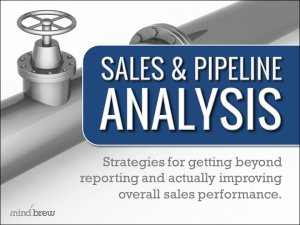
To actually improve overall sales performance in a big way, reporting alone simply WILL NOT get you there. This recorded training session shows you how to make the transition from reporting to true sales and pipeline analysis that can drive improved sales performance at-scale.
How to Use Sales Analysis to Drive More Growth
Sales analysis often has much more potential than it is given credit for. This on-demand webinar explains how to using the analytical processes and underlying data to reveal powerful insights and opportunities for growth.
The Metrics Sales Leaders Should Be Managing
You need to track and manage sales metrics, but which metrics are the most important? In this guide based on research from Vantage Point Performance and the Sales Education Foundation, Jason Jordan reveals the ones that really matter.
Diagnosing Sales Problems
Failing to identify the true root causes of sales performance problems often leads to a frustrating game of Whack-A-Mole. In this on-demand training webinar, learn how to identify and correct the real root causes behind sales performance issues.