If your fiercest competitor called your biggest customer tomorrow with a better deal, how confident are you that they’d stick with you?
Every sales organization says that their key accounts are their lifeblood. They’ll tell you their best customers are their number one priority. That they’ll do anything to keep their critical customers satisfied.
But saying and doing are two different things.
Too often, leadership talks endlessly about protecting and expanding their top customers, while the systems and processes to support those customers look exactly like those for every other account.
Operationalizing the key account mindset
This isn’t a mindset problem. Everyone from management on down to the most junior employee really wants to prioritize key accounts.
The problem is that systemic issues that make it really difficult to give critical accounts the attention they deserve.
What do we mean by “systemic issues”? Here are some examples:
- A lack of understanding of who the key accounts really are
- One-size-fits-all processes that treat small and large accounts the same
- Dependence on hero reps, where growth hinges on a single superstar instead of a repeatable system
- Shallow account criteria, focusing only on immediate revenue instead of potential and strategic fit
To overcome these inherent flaws in the system, you’re going to need a team that can look at your processes holistically and identify where things aren’t working. You need a group that can go beyond top-line revenue to design metrics that surface growth potential. You need folks who can analyze the data to identify who your key accounts really are. You need someone to develop scalable processes that reduce the reliance on sales rock stars.
And of course, the team best positioned to fill this need is sales ops.
Are you neglecting your key accounts?
What about your company? Does your current operating model give important customers an appropriate level of consideration and resources? Or are you just paying lip service to key account management?
If you have room for improvement, a good place to start is with the Retaining and Growing Key Accounts webinar. It can help you get beyond the obvious and leverage more effective criteria for identifying key accounts. And it will show you how to develop the scalable processes and systems you need to systematize your account management.
You might also want to check out Moving the “Meaty Middle”. It delves a little deeper into the pitfalls of relying too heavily on superstar reps. It explains that by improving the performance of the 60% to 70% or your reps who are roughly average — the “meaty middle” — you can make dramatic improvements in the company’s overall success. And it offers ten proven tips for doing just that.
We started by asking if your top customers were at risk of defecting. It might have been even better to ask if you know who your top customers are. And if you do know who they are, do you know what it would take to keep them around?
If you aren’t sure about the answers to any of those questions, it’s time to take a closer look at your key account processes.
Retaining & Growing Key Accounts
Taking a more systemic and programmatic approach to key account retention and growth by developing a real Key Account Program.
Moving the "Meaty Middle"
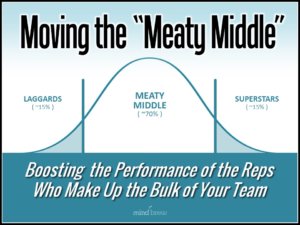
The primary focus for Sales Ops should be on improving the performance of the middle-of-the-road salespeople who comprise the majority of the team. In this on-demand webinar, learn why it's so important and how to make it happen.